MEDIA CONTACT:
Dana Juniel, Movement Advancement Project
February 19, 2026
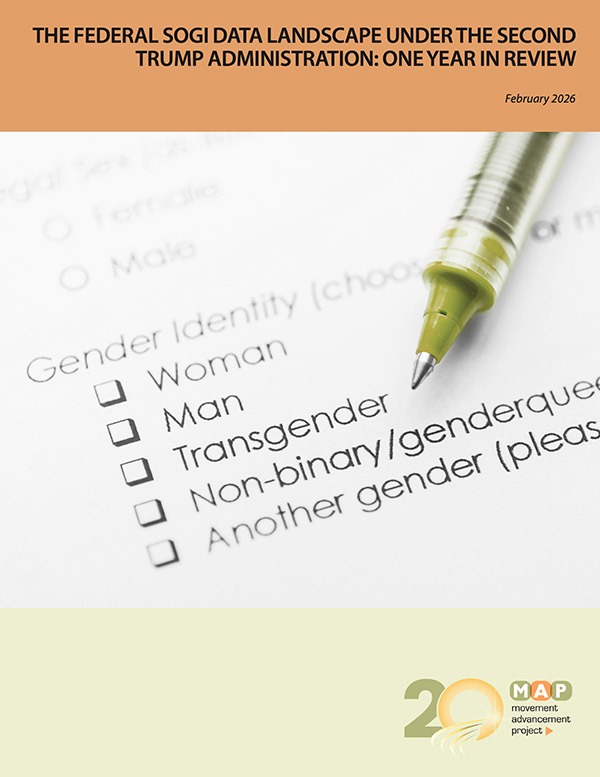
In just the first year of the second Trump administration, the federal government has taken action to pull back or erase key sources of data about LGBTQ people. These data losses are occurring as the administration aggressively advances an anti-LGBTQ—and particularly anti-transgender—policy agenda.
New research by The Williams Institute
finds that approximately 360 federal data collections have removed at least one sexual orientation and/or gender identity (SOGI) measure, the majority of which specifically target transgender, nonbinary, and gender expansive people.
In response, today the Movement Advancement Project (MAP) released a new report that reviews recent progress in federal LGBTQ data collection, documents the scope and consequences of current demographic data removals and rollbacks, and outlines strategies and resources to promote accountability and responsible data governance in an increasingly hostile federal environment.
A shifting DATA LANDSCAPE
After years of substantial progress to strengthen federal data collection on underserved communities, including LGBTQ populations, under the Biden administration, President Trump’s
Executive Order 14168 quickly sought to dismantle any and all institutionalized improvements in federal SOGI data collection processes. The executive order, which seeks to redefine sex for all federal policy purposes as binary and immutable, led to federal agencies removing SOGI data measures on existing data collections, prohibiting their future collection, and stopping ongoing methodological research.
The report explains the critical nature of these data, which enable policymakers, researchers, and service providers to identify disparities, allocate resources equitably, and deliver effective programs and services that respond to the needs of LGBTQ communities. The systematic removal of these measures renders LGBTQ people and their experiences invisible, obscuring the real-world harms and other impacts of policy decisions.
Recent Changes
Due to
83% of SOGI removals not undergoing a formal public notice-and-comment period, little public visibility has been given to these changes. The report includes a list of concrete examples of removals that have occurred over the past 12 months, including the Household Pulse Survey, American Housing Survey, Centers for Disease Control and Prevention’s Behavioral Risk Factor Surveillance System, the National Crime Victimization Survey, and many more.
In addition, the report brings attention to the Census Bureau’s recent decision to halt research assessing the feasibility of adding gender identity measures to the American Community Survey, the nation’s premier survey used to shape evidence based policy decisions, allocate trillions of dollars in public resources, and support enforcement of civil rights laws to protect people from discrimination.
Hiding Harms & Masking Policy Impacts
The elimination of federal LGBTQ data is part of a larger agenda. That agenda includes
cuts to Medicaid,
restrictions on gender-affirming care,
cancelation of LGBTQ health research dollars, elimination of
civil rights protections and attempts to deny the reality that transgender, nonbinary, gender expansive, and intersex people exist and have rights under the law. When SOGI data are selectively erased, altered, or suppressed, it becomes harder to track disparities, enforce civil rights laws, allocate resources fairly, or evaluate whether policies are working as intended.
“Removing SOGI data is not a neutral administrative change; it is a mechanism that obscures harm, limits accountability, and weakens the evidence base needed for effective and equitable policymaking and governance. The rapid elimination of these critical data ensures that harms driven by these anti-LGBTQ policies are more difficult to detect, measure, and challenge.”
– Caroline Medina, MAP’s Senior Advisor for Data Policy and Strategy
Moreover, the increased misuse and weaponization of data has led to increased distrust by underserved communities, which discourages participation, degrading data quality, and reinforcing cycles of invisibility and exclusion.
While LGBTQ communities may be among some of the first to feel these harms, the consequences extend far beyond any single population.
Paths Ahead
Currently, a range of accountability efforts are underway to monitor data removals, challenge unlawful actions, and support ethical, responsible SOGI data collection both at and beyond the federal level.
As the federal government withdraws from collecting SOGI data, it is increasingly critical that states, nonprofits, academic institutions, and private entities ensure ethical, responsible, and well-governed data practices. The report offers recommendations for those interested in LGBTQ-inclusive data collection, in addition to a short list of resources that have been developed to help researchers, policy experts, advocates, and the public understand the evolving landscape of federal data collection, access inclusive datasets, support ongoing advocacy and accountability work, and promote good data governance.
“SOGI data are essential building blocks to help understand how policies are affecting real people, and where interventions are most urgently needed,” Medina added. “Taking action to promote accountability, scientific integrity, and transparency, while combating misuse and protecting communities, is paramount.”
+++
About MAP
The Movement Advancement Project (MAP) provides rigorous research, insight, and analysis that help speed equality and opportunity for all. MAP works to ensure that LGBTQ people and their families can live their lives with dignity, safety, and respect by focusing on three key areas: policy and issue analysis, movement capacity, and effective messaging. MAP’s work also covers a broad range of social justice issues that intersect with the LGBTQ movement, including racial justice, economic justice, and healthcare access.