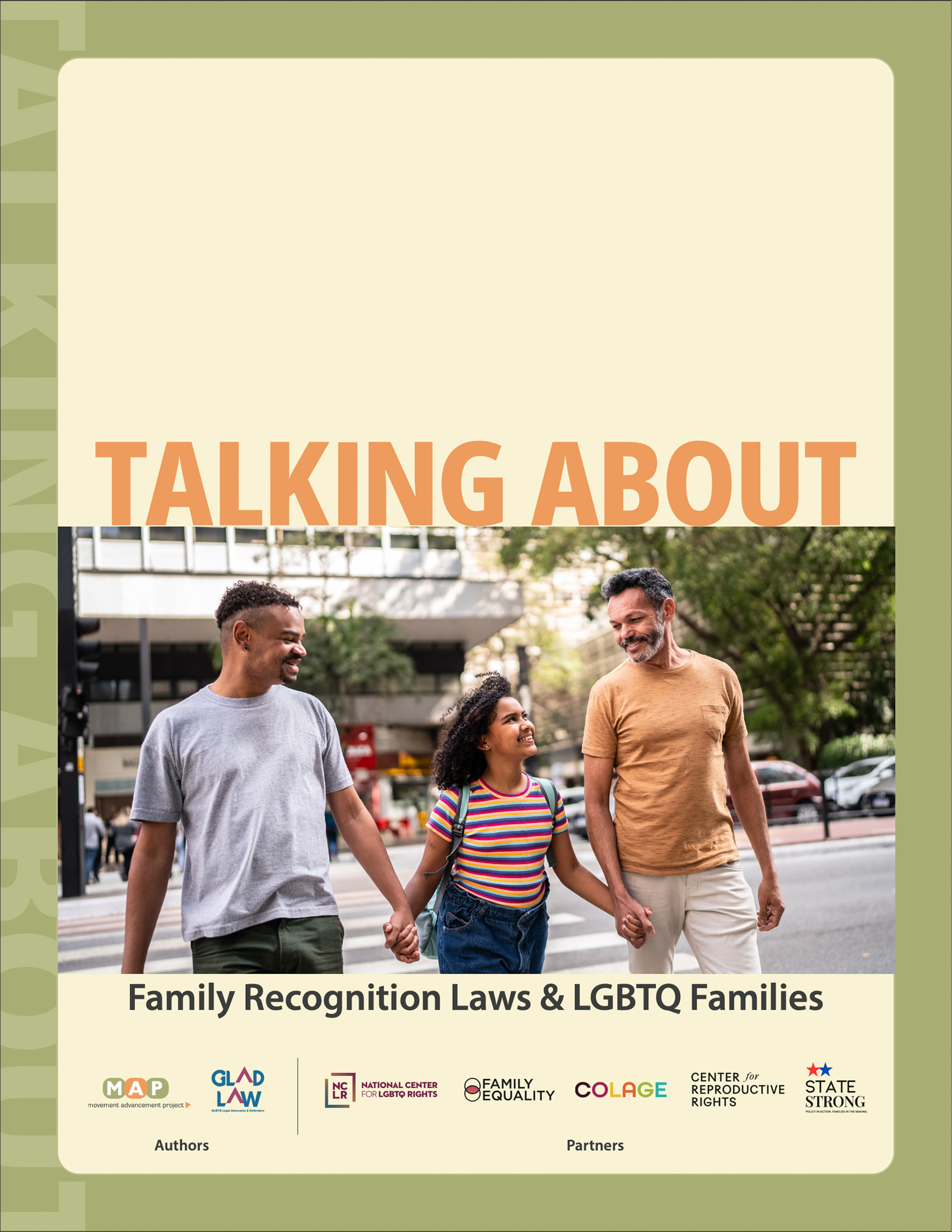
Family recognition laws establish a secure legal relationship between a child and their parent or parents. These legal ties are essential to a child’s security and well-being. However, many state family recognition are out of date and don’t recognize all families—including families built with the assistance of fertility care, and families where a child does not have a biological connection to one or both parents. These outdated laws leave many children and families vulnerable, including LGBTQ families.
Updating family recognition laws provides safeguards not only for LGBTQ families, but also for a wide range of families formed via fertility care. Talking About Family Recognition Laws & LGBTQ Families provides guidance for conversations about these policies that can help conflicted audiences understand the vital importance of clear, accessible, and strong legal child-parent ties—and why families, no matter how they are formed, should be treated equally under the law.
Be the first to know about new reports and MAP news by signing up for our newsletter
Founded in 2006, the Movement Advancement Project (MAP) is an independent, nonprofit think tank that provides rigorous research, insight and communications that help speed equality and opportunity for all.
MAP works to ensure that all people have a fair chance to pursue health and happiness, earn a living, take care of the ones they love, be safe in their communities, and participate in civic life. MAP is a nonprofit 501(c)(3) organization and donations to MAP are 100% tax-deductible. You can read more about MAP and the work we do on our About page.
A limited set of materials is restricted to the staff and board members of LGBTQ movement organizations. Click below to request user access.
Join MAPView our privacy policy.
The term “sexual orientation” is loosely defined as a person’s pattern of romantic or sexual attraction to people of the opposite sex or gender, the same sex or gender, or more than one sex or gender. Laws that explicitly mention sexual orientation primarily protect or harm lesbian, gay, and bisexual people. That said, transgender people who are lesbian, gay or bisexual can be affected by laws that explicitly mention sexual orientation.
“Gender identity” is a person’s deeply-felt inner sense of being male, female, or something else or in-between. “Gender expression” refers to a person’s characteristics and behaviors such as appearance, dress, mannerisms and speech patterns that can be described as masculine, feminine, or something else. Gender identity and expression are independent of sexual orientation, and transgender people may identify as heterosexual, lesbian, gay or bisexual. Laws that explicitly mention “gender identity” or “gender identity and expression” primarily protect or harm transgender people. These laws also can apply to people who are not transgender, but whose sense of gender or manner of dress does not adhere to gender stereotypes.
We appreciate you signing up for the MAP newsletter. You will receive an automatic email confirmation shortly.