Overview
In just the first year of the second Trump administration, the federal government has taken action to pull back or erase key sources of data about LGBTQ people. These data losses are occurring as the administration aggressively advances an anti-LGBTQ—and particularly anti-transgender—policy agenda. New research by The Williams Institute
finds that approximately 360 federal data collections have removed at least one sexual orientation and/or gender identity (SOGI) measure, the majority of which specifically target transgender, nonbinary, and gender expansive people.
This report reviews recent progress in federal LGBTQ data collection, documents the scope and consequences of current demographic data removals and rollbacks, and outlines strategies and resources to promote accountability and responsible data governance in an increasingly hostile federal environment.
The report also explains the critical nature of these data, which enable policymakers, researchers, and service providers to identify disparities, allocate resources equitably, and deliver effective programs and services that respond to the needs of LGBTQ communities. The systematic removal of these measures renders LGBTQ people and their experiences invisible, obscuring the real-world harms and other impacts of policy decisions.
Additional Resources
To view the full-length PDF and related content for this report, click below.
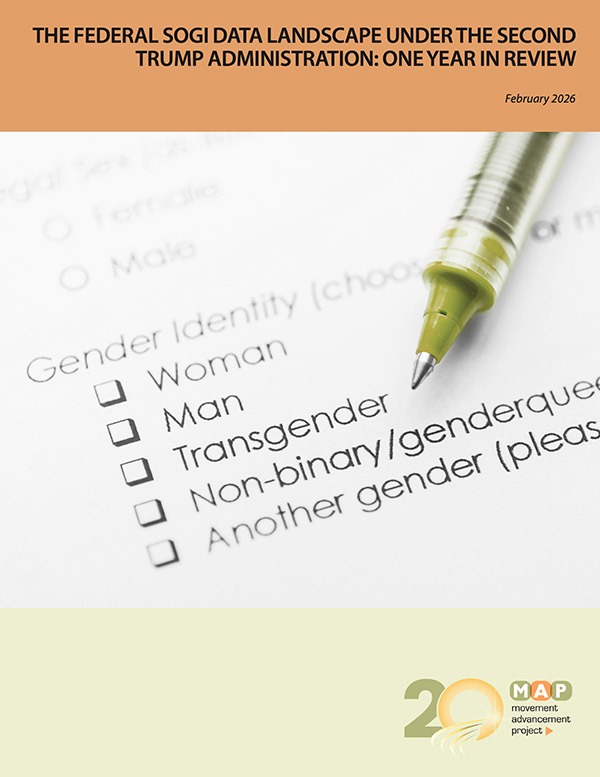
"The Federal SOGI Data Landscape Under the Second Trump Administration: One Year In Review"View Report
Recommended citations
Movement Advancement Project. February 2026.
The Federal SOGI Data Landscape Under the Second Trump Administration: One Year In Review.
www.mapresearch.org/2026-sogi-data-landscape-brief.